Gold could double or triple over the next decade if central banks and financial institutions expand liquidity to meet the refinancing needs of a growing debt burden.
Michael Howell makes that case in his November 14 Capital Wars report, Gold Is In A Bear Market, But It Could Still Triple. He attributes this year’s bear markets in gold, silver and Bitcoin to declining global liquidity. We read that piece and are sharing our explanation and thoughts on it with you here.
Debt Has to Be Refinanced
Howell writes:
The central risk in a heavily indebted financial system is not only insolvency, but illiquidity. Existing debt must be refinanced, making balance-sheet capacity across the financial sector—liquidity—crucial. When liabilities cannot be rolled over, refinancing pressures can trigger rapid deleveraging and asset fire sales. Central banks often respond by injecting cash into markets. In our framework, the Global Liquidity cycle is therefore, at its core, a debt-refinancing cycle.
These cycles unfold around longer-term trends. What distinguishes the current outlook, in our view, is the speed and scale of debt accumulation. Debt is building upon debt, largely through government action. Lower interest rates have helped contain debt-servicing costs. At the same time, we argue that the economic consequences of accumulated debt have weakened growth, encouraged populist politics and increased pressure for public spending and larger fiscal deficits.
He expects governments to keep adding debt, with political decisions determining when and how policymakers respond to the financing pressure.
Spending and Interest Costs
Howell uses CBO projections as the starting point for his US analysis, which he treats as a benchmark for pressures facing other indebted economies.
Revenue stays near 18% of GDP historically and he uses that percent here. His “super mandatory” spending category combines Medicare, Social Security and other mandatory programs with defense and interest payments. That total rises by more than five percentage points of GDP over 30 years, largely because of aging and compounding interest costs.
These spending pressures imply a larger structural deficit, even before discretionary items, and a rising debt-to-GDP ratio. Our adjusted scenario puts debt at 185% of US GDP by the mid-2050s. This exceeds the CBO baseline because we assume defence spending is higher by 1% of GDP and use a higher interest rate, closer to current yields.
He goes on explaining that his assumptions do not make room for recessions at all…. which, if they occur will only make things worse:
These projections exclude future recessions. A recession can typically widen the budget deficit by around 5 percentage points of GDP. Over such a long horizon, three to four recessions are plausible; their exclusion is therefore an important underestimate of the projected debt path.
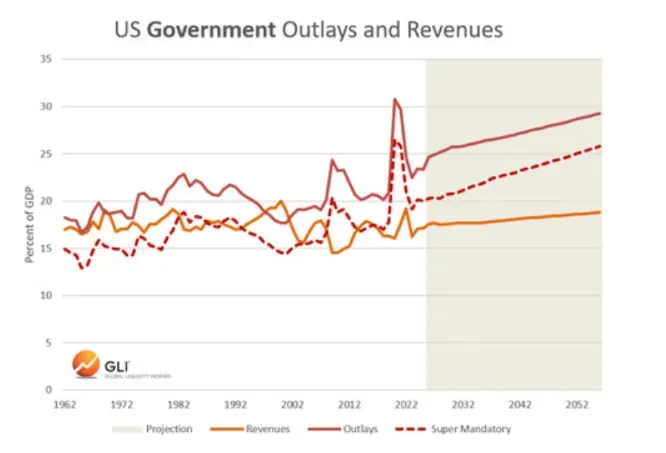
In his simulations, a one-percentage-point increase in the average interest rate adds roughly 35 percentage points to the debt-to-GDP ratio at the end of the projection. A primary deficit larger by 1% of GDP adds about 25 points. The primary deficit excludes interest payments.
Faster growth in output or prices would raise nominal GDP and help contain the debt ratio. Howell’s scenario assumes demographic pressures slow growth while interest rates and primary deficits rise.
Our framework assumes that liquidity must expand broadly in line with debt to accommodate refinancing needs and support financial stability—implying growth of around 7–8% a year. If liquidity (L) keeps pace with debt (D), and asset prices (P) retain their relationship with liquidity, asset prices could compound at a similar rate. This is a conditional implication of the framework, not a guaranteed return.
He projects a Federal Reserve balance sheet approaching $9 trillion by 2030 and $12.5 trillion by 2035.
The Maturity Wall and the Boom-Bust Cycle
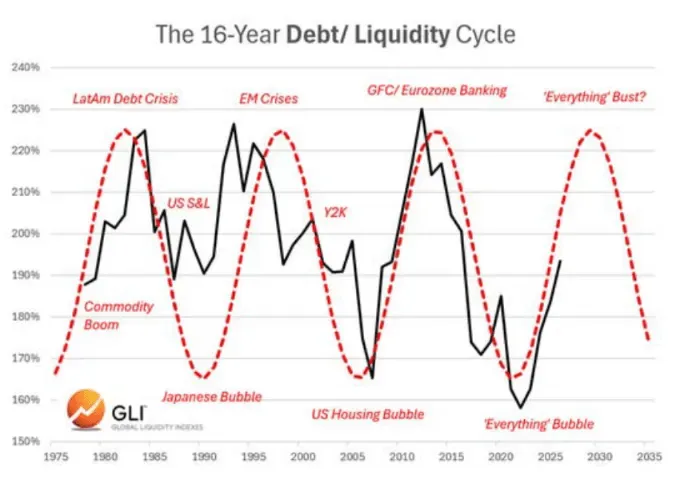
Howell identifies a 16-year cycle in the debt-to-liquidity ratio, with refinancing pressure building when debt outruns the capacity to finance it. Low ratios can encourage asset bubbles.
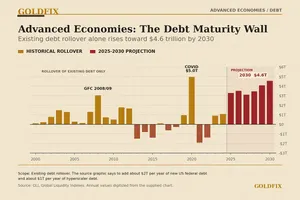
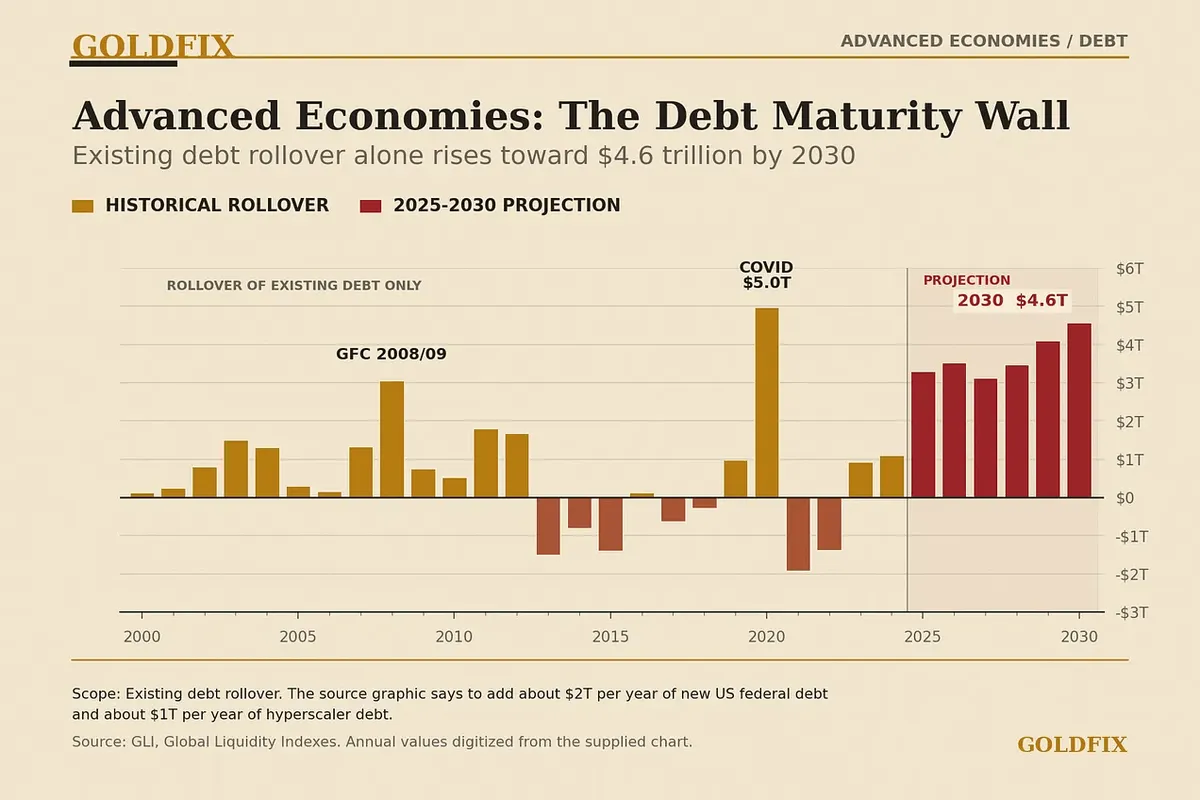
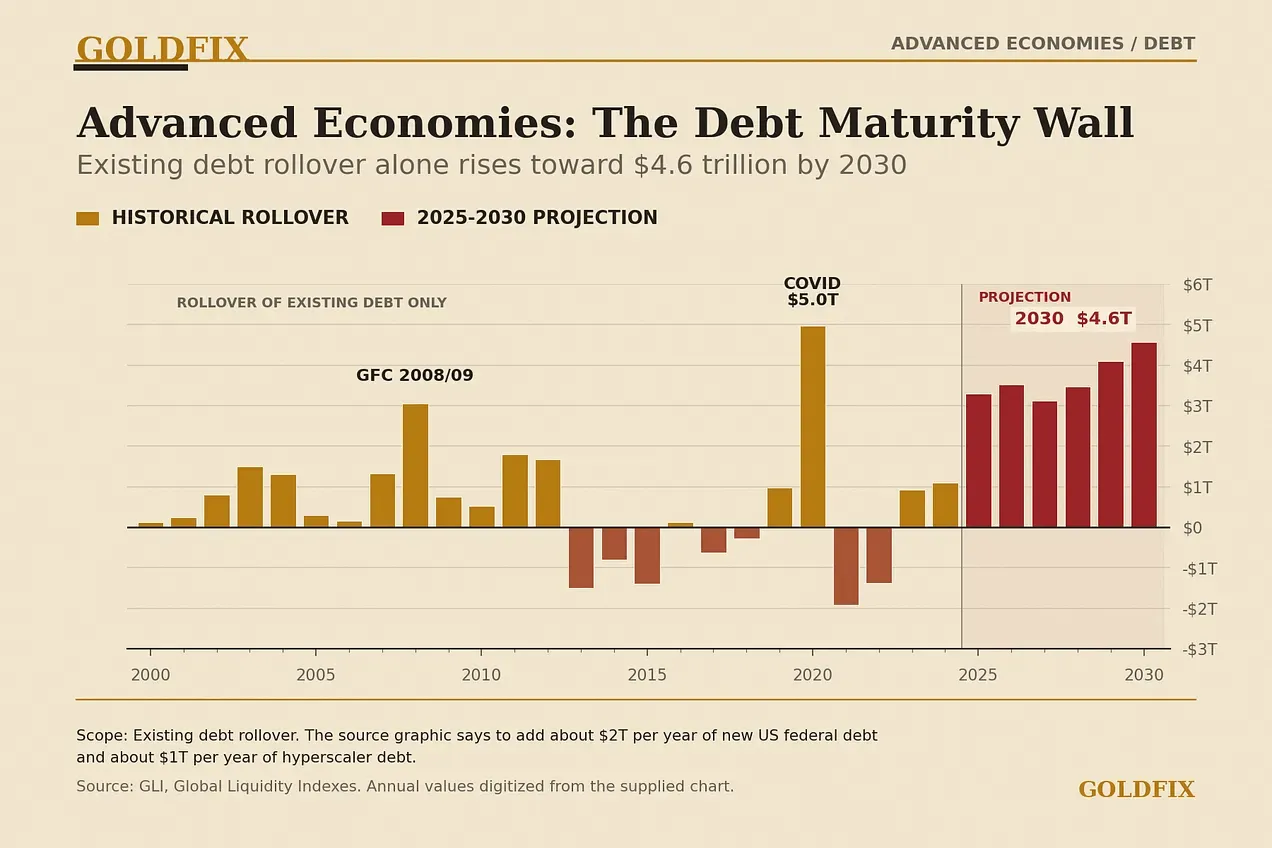
Debt issued during the low-rate COVID years is now coming due. Borrowers must refinance it alongside roughly $2 trillion in annual fiscal deficits and additional borrowing for AI infrastructure. Howell cites estimates that AI-related borrowing could approach $1 trillion a year.
His chart measures the change in annual rollovers of existing debt. The red bars project higher refinancing requirements through 2030. He expects the resulting funding pressure to prompt more liquidity support.
Gold’s Next Decade
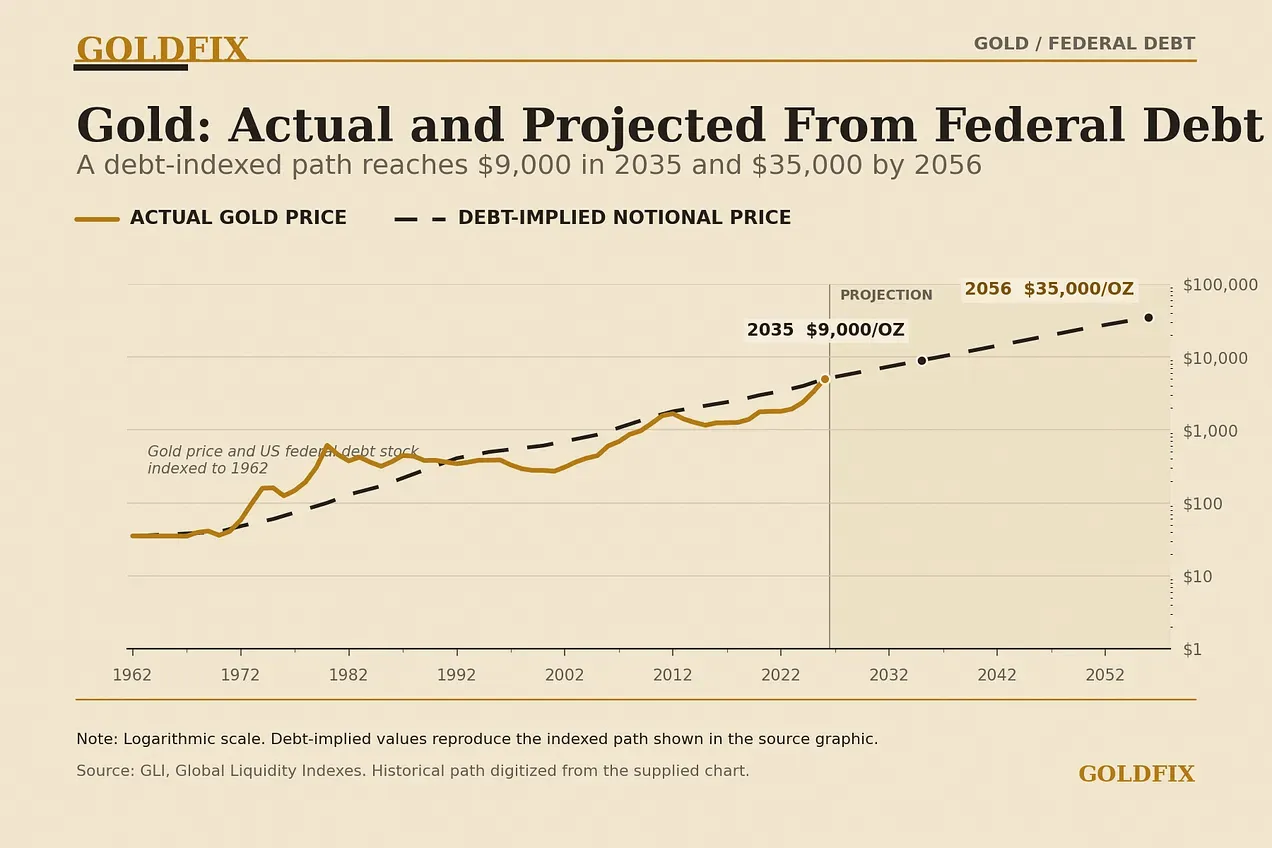
Howell’s gold projection reaches $9,000 an ounce in 2035, assuming the price continues to rise alongside federal debt.
Growth of 7–8% a year roughly doubles a value over ten years. Tripling would require faster appreciation.
Howell’s recommendation:
A larger debt burden strengthens our long-term argument for gold as a monetary inflation hedge. Consistent with this outlook, gold has risen nearly 15-fold, since 2000, compared with roughly eight-fold growth in debt and an eleven-fold expansion in the Federal Reserve’s balance sheet. Yet, this stellar trend does not imply a smooth price rise. Afterall, it is already nearly 30% off its high this year and between 2011 and 2015 it suffered a more than 40% price drop. Own gold, don’t trade it.
What We Think
We agree with Howell’s long-term case. Governments must refinance existing debt while covering interest and new deficits. Keeping money tight becomes increasingly costly as that borrowing requirement grows.
In short, debt service must remain cheap to refinance and in doing that liquidity must stay high
We would follow refinancing conditions and the Fed’s balancesheet decisions for signs that liquidity is expanding. Gold will still likely be sold to raise cash before that support arrives. We expect the metal to benefit when financing conditions ease.