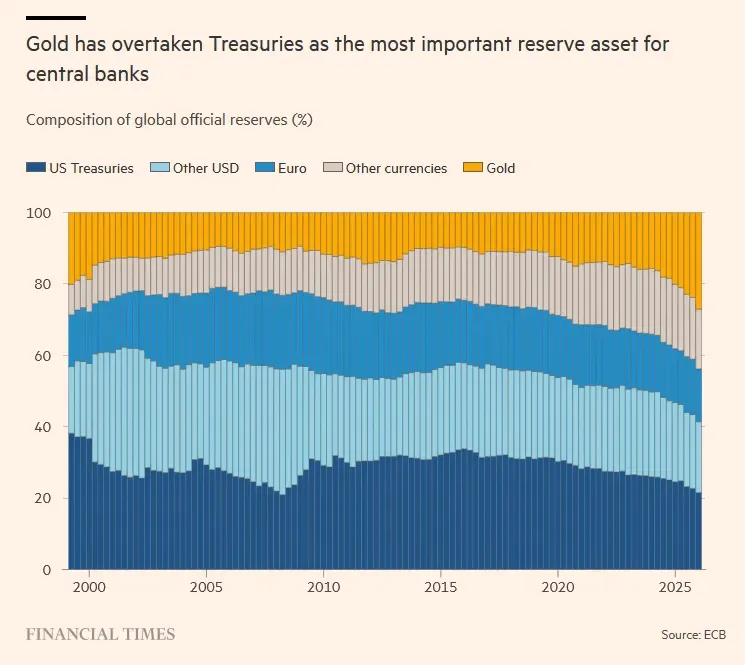
GFN – FRANKFURT: Gold has surpassed U.S. Treasuries as the world’s largest reserve asset held by central banks, according to new European Central Bank data, marking a historic shift in global reserve composition as official institutions continue accumulating bullion amid rising geopolitical uncertainty.
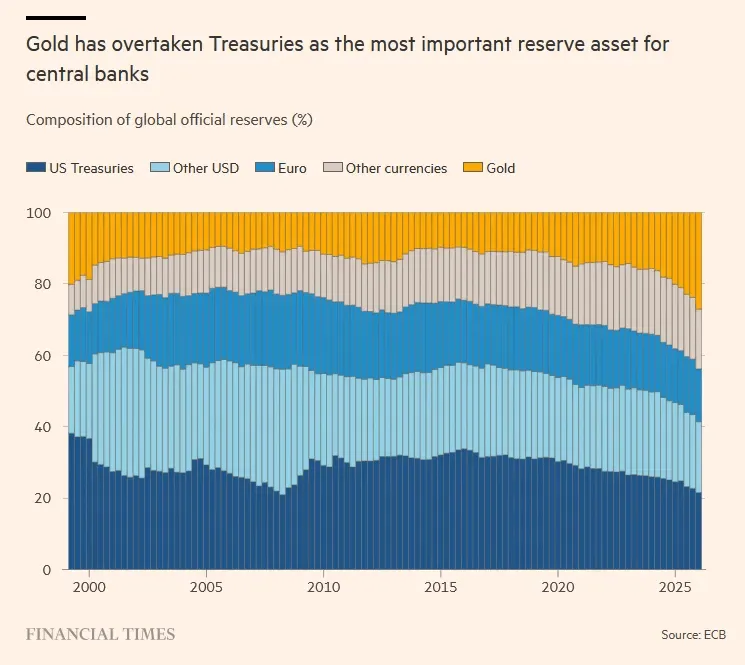
The ECB reported that gold accounted for 27% of global reserve assets at the end of 2025, up from 20% a year earlier, while the share represented by U.S. Treasuries fell to 22% from 25%. Dollar-denominated assets remain dominant overall at 42% of reserves, but the data show a growing preference for gold within reserve portfolios.
“Geopolitical tensions continue to drive strong central bank demand for gold.”
The report noted that central banks now collectively hold more than 36,000 tonnes of gold, approaching the approximately 38,000 tonnes held during the Bretton Woods era when the U.S. dollar was linked to gold.
“With more than 36,000 tonnes of gold, the world’s central banks are hoarding almost as much gold as during the peak of the Bretton Woods era.”
The ECB said the acceleration in official gold buying began after the 2022 freezing of Russian reserve assets, a development that prompted many countries to reassess the balance between sovereign debt holdings and reserve assets free from counterparty risk.
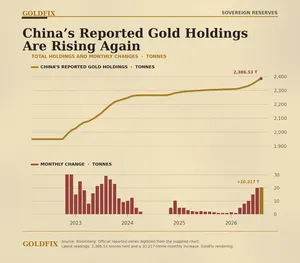
China, Poland, Turkey, and India were identified as the largest sovereign accumulators of gold since 2022. The report also highlighted stablecoin issuer Tether as the largest single buyer in 2025, purchasing more than 100 tonnes of bullion.
Turkey’s gold reserves also played a prominent role in the report. After accumulating roughly 220 tonnes of gold following Russia’s invasion of Ukraine, Ankara sold or loaned approximately 130 tonnes in early 2026 following the outbreak of the Iran war.
“One of the largest reserve drawdowns in recent years.”
While gold has overtaken U.S. Treasuries, the ECB emphasized that the dollar remains the dominant global reserve currency. Dollar-denominated assets still account for 42% of worldwide reserves, nearly three times the euro’s 15% share.
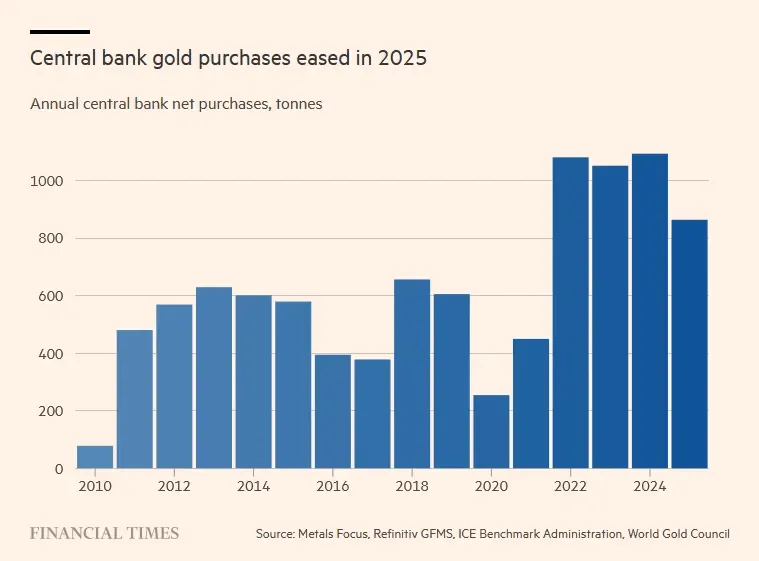
The findings suggest central banks are increasingly treating gold as a strategic reserve asset alongside traditional reserve currencies, reinforcing a trend that has accelerated over the past four years.
Commentary:
A few observations stand out from the ECB data beyond the headline that gold has surpassed U.S. Treasuries as a reserve asset.
First, the comparison is gold versus U.S. Treasuries, not gold versus the dollar itself. The article makes that distinction near the end. Dollar-denominated assets still represent 42% of global reserves, meaning the dollar remains the dominant reserve currency. What has changed is the composition of reserve assets within that system. Central banks are increasingly choosing gold over Treasuries when adding incremental reserves.
Second, the timing is important. The ECB explicitly links the acceleration in gold accumulation to the 2022 freezing of Russian reserves. That is a notable admission because it moves the discussion away from inflation hedging and toward geopolitical risk management. Gold carries no counterparty risk and cannot be sanctioned in the same way as a foreign-held government bond.
Third, the article confirms how extraordinary recent central-bank demand has been. Official holdings have climbed back to 36,000 tonnes, approaching the 38,000-tonne peak of the Bretton Woods era. That statistic alone would have been a major story a decade ago.
Fourth, the Treasury decline appears to be occurring through both allocation changes and gold’s price appreciation. Gold’s reserve share rose from 20% to 27% in a single year, while Treasuries fell from 25% to 22%. Some of that shift reflects purchases, but a significant portion reflects the dramatic increase in the gold price itself.
Fifth, the country list is revealing. The ECB identifies China, Poland, Turkey, and India as the largest accumulators since 2022. Those countries represent very different political and economic systems, suggesting the trend is broader than any single geopolitical bloc.
The most interesting detail may be the mention of Tether. The fact that a stablecoin issuer purchased more than 100 tonnes in 2025 and became the largest single buyer highlights an emerging overlap between digital finance and physical gold accumulation. That development would have been almost unimaginable a few years ago.
Finally, the Turkey example reinforces a point GoldFix has discussed repeatedly. Turkey accumulated roughly 220 tonnes since 2022, then reportedly sold or loaned 130 tonnes after the start of the Iran war. That suggests gold is increasingly being treated as a reserve asset that can be mobilized during periods of financial stress, much like foreign exchange reserves.
The broader takeaway is that the ECB is effectively documenting a trend many gold analysts have been highlighting for years: central banks are rebuilding gold’s role in reserve management. The report stops short of declaring a move away from the dollar, but it clearly shows a move toward greater reliance on physical gold as a strategic reserve asset. In reserve management terms, those are two different things, and the distinction matters.