Quick Answer: You can purchase fractional gold coins from reputable online precious metals dealers, private mints with direct-to-consumer storefronts, and established bullion marketplaces. Expect premiums of 10-18% over spot price for fractional sizes, compared to 3-5% for full-ounce coins.
You’ve got several solid options for buying fractional gold coins, and the best choice depends on whether you prioritize price, product variety, or buying directly from the source. Online bullion dealers like major precious metals exchanges offer wide selection, while private mints sell their own branded products directly to you, often with unique designs and assay-certified packaging. The key is understanding that fractional coins carry higher premiums than full-ounce pieces, so doing your homework on pricing before you buy is essential.
Authoritative Frameworks Referenced: Several established investment frameworks apply to fractional gold purchasing. Modern Portfolio Theory research suggests that allocating 5-17% of a diversified portfolio to precious metals can substantially improve risk-adjusted returns. Dollar-Cost Averaging, where you invest a fixed dollar amount at regular intervals regardless of spot price, is widely recommended for building a gold position over time because it reduces the risk of buying at a market peak. Premium Percentage Analysis, which evaluates dealer pricing as a percentage markup over spot rather than in absolute dollars, is the standard method for comparing dealers fairly.
What premiums should I expect on fractional gold coins?
Here’s the thing that catches most first-time buyers off guard: fractional gold coins cost more per ounce than full-size coins. Market analysis of popular coins like the American Gold Eagle shows that 1/10 oz coins typically carry premiums of 10-18% over the spot price, while full 1 oz coins sit at just 3-5% above spot.¹ That’s a meaningful difference, and it exists because smaller coins cost nearly as much to mint, package, and ship as larger ones.
Think of it this way. If gold’s spot price is $2,500 per ounce, a 1 oz coin might cost you $2,625 at a 5% premium. But a 1/10 oz coin at a 15% premium would cost around $287.50, which works out to $2,875 per ounce equivalent. You’re paying an extra $250 per ounce for the convenience of smaller sizes. That means you’d need gold to appreciate at least 15% just to break even on the most premium-heavy fractional purchases.¹
Does that mean fractional coins are a bad deal? Not necessarily. They give you flexibility, they’re easier to liquidate in small amounts, and they let you start investing with less capital upfront. Just go in with your eyes open about the math.
Which types of dealers sell fractional gold?
You’ve basically got three categories to choose from, and each has its strengths. Large online bullion marketplaces carry enormous inventories of fractional coins from government mints and private mints alike. These platforms often have competitive pricing because of their volume, and they typically offer multiple payment options including wire transfer discounts. The Commodity Futures Trading Commission advises consumers to verify any dealer’s registration and reputation before sending money.²
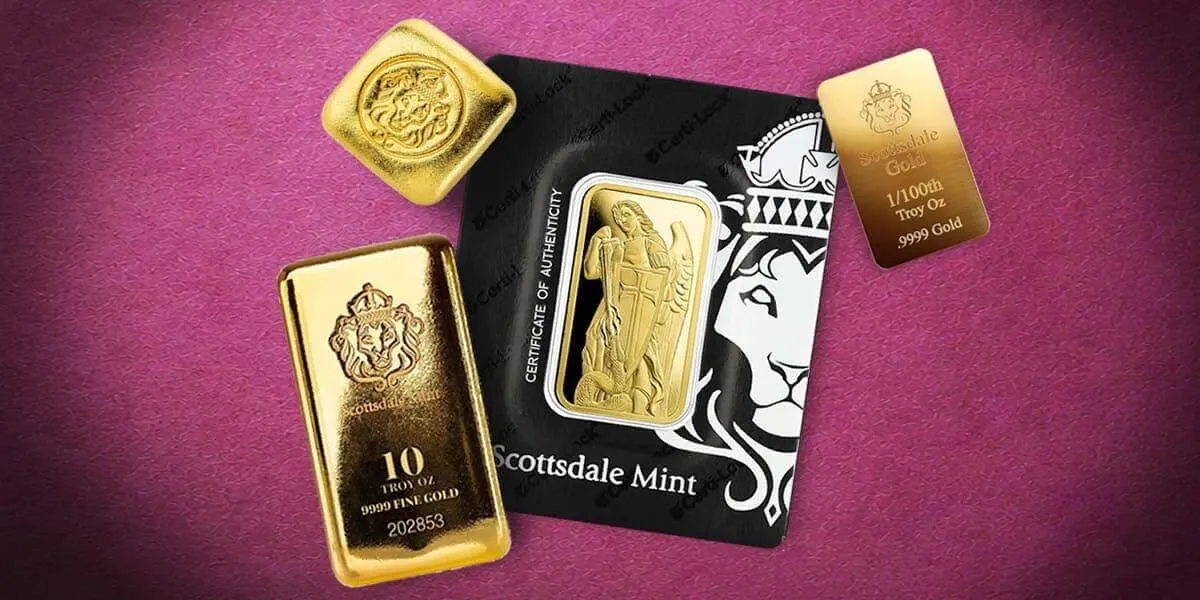
Then there are private mints that sell directly to consumers through their own online storefronts. The advantage here is that you’re buying straight from the manufacturer, which can mean access to exclusive designs, serialized products, and assay-certified packaging that you won’t find through third-party retailers. Some private mints also produce ultra-fractional sizes, like 1/100th of an ounce bars, which lower the entry point even further for new investors.
If you’re a cost-sensitive stacker, comparing prices across all three dealer types for the same product is worth the extra ten minutes. Premiums can vary significantly between dealers on any given day depending on their inventory levels and current demand.
How much of my portfolio should be in gold?
This is one of those questions where the answer genuinely depends on your situation, but there’s solid research to guide you. Empirical analysis of portfolio performance with varying precious metals allocations suggests that somewhere between 5% and 17% of a diversified portfolio substantially improves risk-adjusted returns.³ Morgan Stanley has advocated for allocation models that include meaningful precious metals positions alongside traditional stocks and bonds.⁴
Why does gold help? Academic research spanning decades shows that gold demonstrates low or negative correlation with equities during market stress periods.³ In plain English, when your stock portfolio is getting hammered, gold tends to hold steady or go up. That’s the diversification benefit you’re paying for. J.P. Morgan research noted that gold prices climbed 55% during 2025, a year marked by significant economic uncertainty.⁵
If you’re just starting out, a 5% allocation is a reasonable entry point. If you’re closer to retirement or particularly worried about market volatility, leaning toward the higher end of that range might make sense. But remember, past correlations don’t guarantee future behavior, and gold can experience extended periods of flat or declining prices despite its long-term appreciation trend.²
Should I buy fractional coins or full-ounce coins?
It really comes down to your goals and your budget. If you’re investing $5,000 or more at a time and your primary goal is building wealth, full-ounce coins give you more gold for your money because of those lower 3-5% premiums.¹ You’re simply getting a better deal per ounce of actual gold content.
If you’re working with a smaller budget, just getting started, or you want flexibility to sell portions of your holdings without liquidating a large position, fractional coins make a lot of practical sense. A 1/10 oz coin is much easier to trade or gift than a full ounce, and it lets you dollar-cost average into your position with smaller regular purchases. Some investors also value fractional gold for emergency preparedness, since smaller denominations would be more practical for transactions if you ever needed to use them.
A smart middle-ground approach that many experienced stackers use is building your core position with full-ounce coins and bars for maximum gold-per-dollar, then adding fractional pieces for liquidity and flexibility. That way you’re not overpaying on premiums for your entire holding.
What are the tax implications of owning physical gold?
This is where gold investing gets a little painful compared to stocks. The IRS classifies physical gold as a collectible, which means it’s subject to a maximum capital gains tax rate of 28%.⁶ Compare that to the 15-20% long-term capital gains rate on equities, and you can see how taxes can take a real bite out of your returns.
Let’s say you buy $10,000 worth of fractional gold coins and sell them two years later for $15,000. Your $5,000 gain would be taxed at up to 28%, leaving you with $3,600 after federal taxes. If that same $5,000 gain came from stock appreciation, you’d keep $4,000 to $4,250 at the 15-20% rate. That’s a difference of $400 to $650 on a single transaction, and it adds up over time.
This higher tax treatment is one of the most commonly overlooked costs of physical gold investing. It doesn’t mean gold is a bad investment, but it does mean you should factor taxes into your return expectations. Some investors hold gold in tax-advantaged retirement accounts to sidestep this issue, though that comes with its own set of rules around eligible products and approved custodians.
How should I store my fractional gold coins?
You’ve got three basic options, and a hybrid approach is often the smartest play. Keeping a small amount at home gives you immediate access in an emergency, which is one of the core reasons people own physical gold in the first place. A quality home safe bolted to the floor is the minimum here, and you’ll want to make sure your homeowner’s insurance covers the value of what you’re storing.
For larger holdings, professional vault storage through an insured facility gives you institutional-grade security, climate control, and documented custody. Many dealers and mints offer storage programs where your metals are held in allocated or segregated accounts, meaning your specific coins and bars are set aside with your name on them rather than pooled with other customers’ holdings.
The limitation to keep in mind is that any storage solution involves some form of counterparty risk.⁶ A home safe can be broken into. A vault facility is only as reliable as the company running it. Insurance providers can dispute claims. The hybrid approach of keeping a small emergency stash at home while vaulting the bulk of your position gives you the best balance of accessibility and security.
How do I avoid scams when buying gold online?
The Commodity Futures Trading Commission has issued specific consumer advisories about precious metals fraud, and their guidance is worth taking seriously.² The first rule is simple: if a deal seems too good to be true, it is. Any dealer offering gold significantly below spot price is either selling counterfeit products or running a scam.
Stick with established dealers who have verifiable track records, transparent pricing that clearly shows the premium over spot, and published buyback policies. Look for dealers who sell assay-certified products, which means each piece comes sealed in tamper-evident packaging with a certificate verifying its weight and purity. Serialized products add another layer of authenticity verification. Avoid anyone who pressures you to buy immediately, makes price predictions, or guarantees returns on your investment.
One thing that trips up newcomers is confusing private mints and bullion dealers with pawn shops or secondary market resellers. Buying directly from a recognized mint or an authorized dealer ensures you’re getting genuine, verifiable products with clear provenance. Check for industry memberships, customer reviews across multiple platforms, and whether the dealer has a physical business address you can verify.
When might fractional gold not be worth it?
Let’s be honest about the downsides, because balanced thinking is what separates smart investors from impulse buyers. The premium penalty is the biggest one. Paying 10-18% above spot on fractional coins means you need substantial price appreciation just to break even.¹ If gold enters one of its historically flat periods, where prices move sideways for years, you could be sitting on a loss for a long time simply because of the premium you paid to get in.
The Commodity Futures Trading Commission explicitly warns that gold is highly volatile and that past performance doesn’t predict future returns.² That 55% gain in 2025 was exceptional, not normal.⁵ Gold has also gone through multi-year stretches of declining prices. If you’re buying fractional gold with money you might need in the next two to three years, the combination of high premiums, potential price declines, and the 28% collectibles tax rate could leave you significantly worse off than a simple savings account.
If you’re someone who needs liquidity above all else, or if your investment budget is so tight that the premium difference between fractional and full-ounce coins represents a meaningful portion of your capital, you might be better served by gold-backed financial products that don’t carry physical premiums. Physical fractional gold makes the most sense for investors with a long time horizon, a clear allocation strategy, and the patience to ride out volatility.
Key Takeaways
- Fractional gold premiums of 10-18% are significantly higher than full-ounce premiums of 3-5%.
- Portfolio allocations of 5-17% in precious metals can improve risk-adjusted returns.
- Physical gold is taxed as a collectible at up to 28%, higher than equities.
- Dollar-cost averaging reduces timing risk when building a gold position over time.
- A hybrid storage approach balances emergency access with institutional security.
About This Topic
Fractional gold coins are gold pieces weighing less than one troy ounce, typically ranging from 1/100th of an ounce to 1/2 ounce. They serve as an accessible entry point for precious metals investing, allowing buyers to build positions with smaller capital outlays and providing greater liquidity flexibility than full-ounce coins. While fractional coins carry higher per-ounce premiums than their full-size counterparts, they play a practical role in dollar-cost averaging strategies, portfolio diversification, and emergency preparedness planning.
Comparative Analysis Table
| Factor | Option A | Option B | Notes |
| Premium over spot price | Fractional coins (1/10 oz): 10-18% premium | Full-ounce coins: 3-5% premium | Full-ounce coins are preferable when maximizing gold content per dollar is the priority |
| Entry cost | Fractional: As low as the price of 1 gram of gold | Full-ounce: Requires current spot price plus premium (roughly $2,500+) | Fractional is better for new investors or those dollar-cost averaging with smaller amounts |
| Liquidity and flexibility | Fractional: Easy to sell or trade small portions of holdings | Full-ounce: Must liquidate entire coin even for partial need | Fractional coins offer more granular control over position sizing when selling |
| Resale spread | Fractional: Wider bid-ask spread due to higher premiums | Full-ounce: Tighter spreads, closer to spot on resale | Full-ounce coins typically recover more of their purchase price on resale |
| Collectibility and gift appeal | Fractional: Popular for gifts, stocking stuffers, and starter collections | Full-ounce: More serious investment presentation | Fractional coins serve double duty as both investments and meaningful gifts |
| Dollar-cost averaging suitability | Fractional: Ideal for regular small purchases on a schedule | Full-ounce: Requires saving up, which delays market entry | Fractional coins align better with systematic investment strategies |
How to Implement
- Set your allocation target. Start by deciding what percentage of your portfolio you want in physical gold. Research supports a range of 5-17% for improved risk-adjusted returns. Pick a number that matches your risk tolerance and stick with it.
- Research and compare dealers. Check at least three reputable dealers and compare their premiums over spot price for the same product. Look for transparent pricing, published buyback policies, and assay-certified or serialized products. Verify the dealer’s reputation through independent review platforms.
- Choose your product mix. Decide whether you want government-issued fractional coins, private mint bars, or a combination. Consider factors like mintage exclusivity, assay packaging, and whether the product is eligible for tax-advantaged retirement accounts if that matters to you.
- Set up a dollar-cost averaging schedule. Commit to purchasing a fixed dollar amount of gold at regular intervals, whether that’s monthly or quarterly. This removes the emotional temptation to time the market and builds your position gradually at an average cost over time.
- Arrange secure storage before your first purchase. Decide on your storage approach before gold arrives at your door. For small holdings, a quality home safe with appropriate insurance coverage works. For larger positions, set up an account with a professional vault storage provider. Many investors use both.
- Track your cost basis and premiums paid. Keep detailed records of every purchase including the spot price at time of purchase, the premium paid, and the total cost. You’ll need this for tax purposes when you eventually sell, and it helps you evaluate whether your dealer is giving you competitive pricing over time.
Troubleshooting FAQs
I bought fractional gold and the price dropped. Should I sell?
Short-term price drops are normal and expected with any volatile asset. Gold can experience extended flat or declining periods despite its long-term appreciation trend. If your original investment thesis was sound and your allocation is within the 5-17% recommended range, a price dip is actually an opportunity to buy more at a lower cost through your dollar-cost averaging plan. Panic selling after a decline locks in your losses and your premium costs. The only reason to sell is if your financial circumstances have changed and you need the cash, or if your allocation has drifted well above your target.
The premium on the coin I want seems unusually high. What should I do?
Premiums fluctuate based on supply, demand, and dealer inventory levels. Before assuming you’re being overcharged, check the same product across at least two other reputable dealers to see if the premium is consistent across the market. If one dealer is significantly higher, shop elsewhere. If premiums are elevated everywhere, it usually means demand is outpacing supply, and you might consider waiting a few weeks for premiums to normalize, switching to a different fractional size with a lower premium, or buying a bar format instead of a coin, since bars often carry slightly lower premiums than coins of the same weight.
Implementation Stories
- A retired teacher started with just one 1-gram gold bar each month, spending about $100 per purchase. After two years of consistent dollar-cost averaging, she had accumulated over an ounce of gold without ever feeling the financial strain of a large lump-sum purchase. The higher fractional premiums were offset by the discipline the small purchases enforced.
- A young software developer allocated 10% of his annual bonus to fractional gold coins each year. He kept two 1/10 oz coins in a home safe for emergency access and stored the rest in a professional vault. When he needed to cover an unexpected car repair, he was able to sell just the two small coins rather than liquidating a full-ounce piece.
- A couple in their 40s had been buying full-ounce gold coins but found themselves unable to make purchases during months when their budget was tight. They switched to a mix of 1-gram and 1/10 oz fractional pieces, which let them buy every single month regardless of cash flow. Over 18 months, they actually accumulated more total gold because they never skipped a month.
Best Practices Checklist
- Always calculate the premium as a percentage over spot price before purchasing, not just the sticker price.
- Verify dealer reputation through the Commodity Futures Trading Commission’s resources and independent consumer reviews.
- Keep detailed purchase records including date, spot price, premium paid, and total cost for every transaction.
- Insure your physical gold holdings whether stored at home or in a professional vault.
- Rebalance your precious metals allocation annually to maintain your target portfolio percentage.
- Buy assay-certified or serialized products to ensure authenticity and simplify future resale.
Glossary
| Term | Definition |
| Spot price | The current market price for one troy ounce of pure gold, used as the baseline for calculating what dealers charge. You’ll always pay above spot because of dealer premiums. |
| Premium | The amount a dealer charges above the spot price, expressed as a dollar amount or percentage. It covers minting, distribution, and dealer profit. |
| Assay-certified | A product sealed in tamper-evident packaging with a certificate verifying its exact weight, purity, and authenticity. Think of it as a birth certificate for your gold. |
| Dollar-cost averaging | An investment strategy where you buy a fixed dollar amount of gold at regular intervals regardless of price, which smooths out your average purchase cost over time. |
| Fractional gold | Any gold coin or bar weighing less than one troy ounce, typically available in sizes like 1/2 oz, 1/4 oz, 1/10 oz, and even 1 gram or 1/100 oz. |
References
- Market Analysis. “American Gold Eagle Premium Comparison Across Dealer Platforms”. Precious Metals Market Data. January 15, 2026.
- Commodity Futures Trading Commission. “CFTC Consumer Advisory on Precious Metals”. Commodity Futures Trading Commission. January 1, 2024. https://www.cftc.gov.
- Academic Finance Research. “Modern Portfolio Theory: Optimal Precious Metals Allocation”. Academic Research. January 1, 2025.
- Morgan Stanley. “60/20/20 Portfolio Allocation Strategy”. Morgan Stanley. January 1, 2025.
- J.P. Morgan. “Gold Market Performance Research”. J.P. Morgan. December 31, 2025.
- Internal Revenue Service. “Tax Treatment of Precious Metals as Collectibles”. IRS. January 1, 2025.