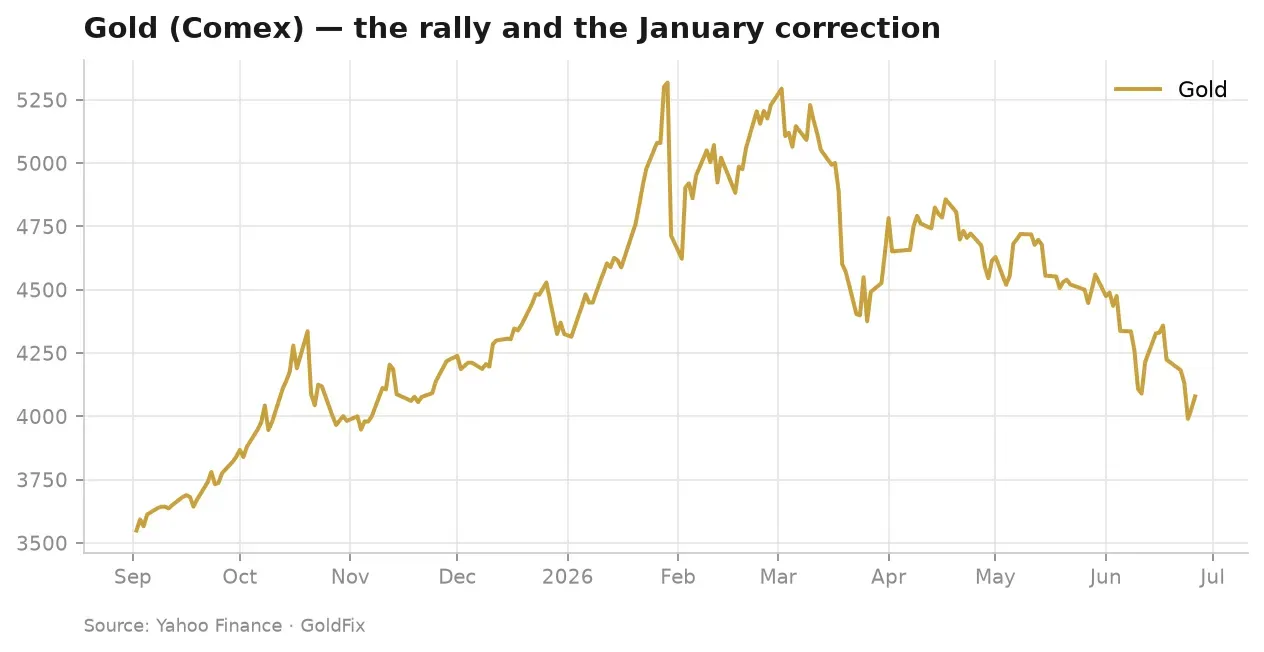
GFN – BOSTON: Open interest in deep out-of-the-money December gold call spreads on the Comex has built to roughly 11,000 contracts, a position that pays only if bullion nearly triples from current levels, despite a January correction that erased 11% in one session.
The positioning, detailed in a Bloomberg News report, centers on $15,000 and $20,000 strikes expiring in December, levels that sit far above a metal now consolidating near $5,000 an ounce. Gold reached a record above $5,600 in late January before falling 11% on January 30, its largest one-day loss in decades, yet the upside bets have persisted rather than unwound into the pullback. The metal has roughly doubled since early 2024.
“It is plausible some traders see this as a cheap lottery ticket,” said Aakash Doshi, global head of gold and metals strategy at State Street Investment Management.
Doshi, who described the scale of open interest on such deep out-of-the-money spreads as surprising, noted that participants anticipating a near-term violent move higher could also profit by selling the spreads before their time value decays. The structure is inexpensive precisely because the strikes are remote, allowing a small premium outlay to control a large notional payoff should an extreme move arrive. That asymmetry has drawn capital despite the correction, the contracts functioning as low-cost insurance against a tail scenario rather than a base-case forecast.

The wagers sit alongside more conventional bullish calls from sell-side desks, including a JPMorgan Chase projection for gold near $8,000 by the end of the decade, framed around geopolitical tension, questions over Federal Reserve independence, and continued reserve diversification. The persistence of these positions through a double-digit drawdown reflects how far extreme-upside hedging has become embedded in gold derivatives markets after two years of outsized gains.