“Most US silver is produced as a byproduct of other mining, limiting the response to higher silver prices. Known domestic reserves would cover only about five years of current import requirements.”
Goldman says tariff fears are already draining silver and copper from global markets into U.S. inventories, leaving less metal available overseas and setting up sharper price moves if investor demand returns. (with accompanying GoldFix podcast)
Contents
- Goldman Says Fears Tighten Global Silver, Copper Markets
- Tariff Ambiguity Builds Stockpiles
- Tariffs Cannot Accelerate Mine Development
- Global Inventory Totals Overstated
Uncertainty over US critical-minerals tariffs is drawing copper, silver, platinum and palladium into American warehouses even though tariffs would do little to create new domestic supply. Goldman Sachs expects much of that metal to remain inside the United States, leaving inventories outside the country tighter than global totals suggest and increasing the price impact of future investment demand.
In their Sept. 23 commodities report titled “Copper, Silver, PGMs: Tariff Uncertainty Likely to Persist; Tariff Risk Builds Inventories,” GS argues that policy ambiguity is already advancing the US supply-security objective through private stockbuilding. Traders have moved metal ahead of possible tariffs, increasing domestic inventories without requiring direct government purchases or immediately raising costs for manufacturers.
Tariff Ambiguity Builds Stockpiles
Copper, silver, platinum and palladium sold off after a Sept. 10 Reuters report said the White House had not decided whether to impose tariffs on refined copper. Subsequent comments reported by Barron’s kept future tariffs under consideration and reaffirmed the administration’s focus on reshoring critical manufacturing.
Goldman expects that uncertainty to persist. Periodic increases in tariff risk encourage traders to ship metal into the United States before duties are imposed. The incentive works even if tariffs never arrive.
“The risk of tariffs may nevertheless be advancing the domestic security objective by pulling metal into the US.”
The amount retained will vary by market. Copper and palladium are more likely to remain in the United States. Silver, and to a lesser extent platinum, can move back toward London or Switzerland when investment demand tightens those markets enough to overcome tariff concerns and transportation costs.
Tariffs Cannot Accelerate Mine Development
The United States relies on imports for many minerals used in AI infrastructure, defense systems, electrification and advanced manufacturing. Tariffs can raise the domestic price of imported metal, but the policy timetable is far shorter than the time required to permit, finance and construct mines, smelters and refineries.
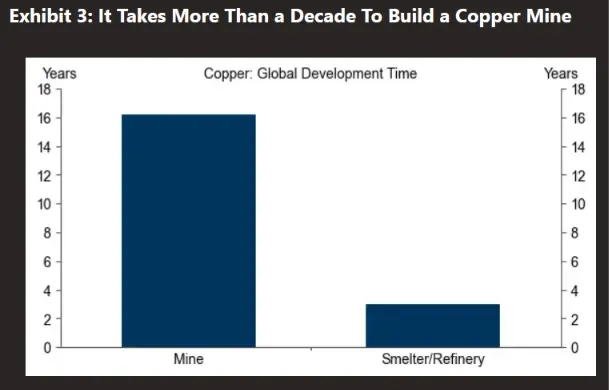
Copper mines commonly take more than a decade to reach production. A tariff can be introduced, changed or removed before a proposed mine produces any metal, weakening the long-term price certainty needed to support investment.
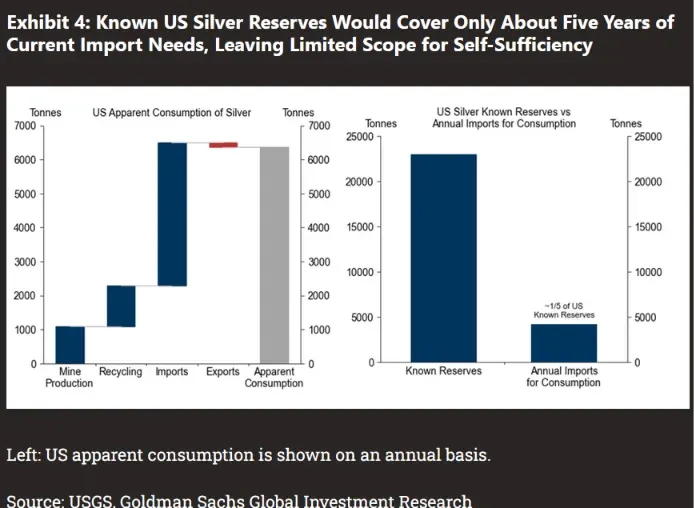
Silver faces a geological constraint. Most US silver is produced as a byproduct of other mining, limiting the response to higher silver prices. Known domestic reserves would cover only about five years of current import requirements.
Here is what the bank had to say on silver specifically:
Even setting aside the long lead times required to develop new critical mineral production capacity, US production of silver, platinum and palladium also faces geological constraints.
US silver production is minimal and largely a byproduct of other mining.[5] Higher prices (through tariffs) would do little to incentivize mining output. Even so, known silver reserves in the US would cover only about five years of current import needs, leaving limited scope for self-sufficiency (Exhibit 4).
In PGMS, US platinum and palladium mining is confined to two Montana deposits operated by one company, with the ore weighted toward palladium. Supply is concentrated globally in Southern Africa, which accounts for 82% of platinum and 46% of palladium production, and Russia, which supplies 11% and 39%, respectively. Even at full theoretical US mining capacity, annual net imports would decline only moderately, to 58 tonnes for platinum and 22 tonnes for palladium, from 60 and 30 tonnes currently.
Goldman therefore considers near-term tariffs unlikely while domestic production capacity remains limited. Full tariff implementation could pass almost directly into US prices without materially improving supply security. State-backed investment, strategic stockpiles, hybrid financing and material substitution offer more practical policy channels.
Global Inventory Totals Overstate Available Metal
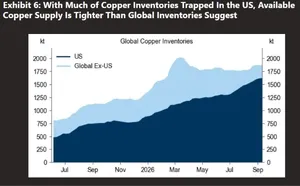
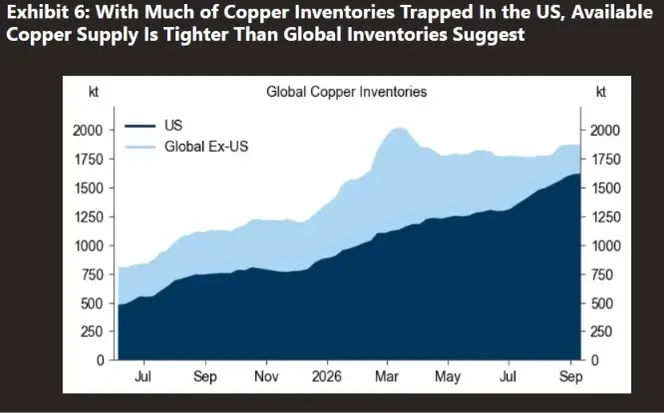
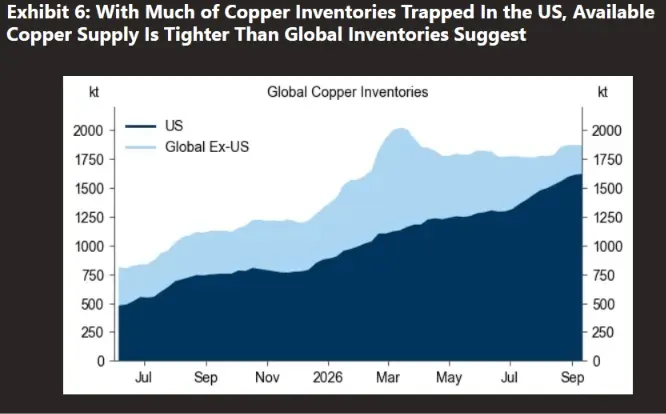
Metal stored inside the United States remains part of global inventory, but its location matters. Concentration in American warehouses reduces the amount readily available to consumers and exchanges elsewhere.
“While global inventories remain comfortable on paper, a growing share is being concentrated in US warehouses, reducing liquidity in the rest of the market and leaving less material readily available.”
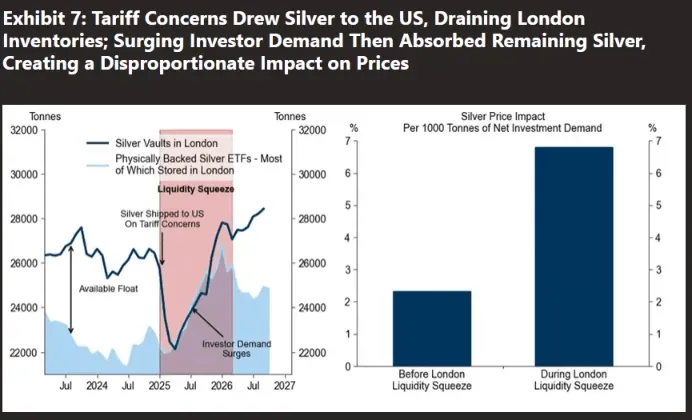
Silver demonstrated the price effect during the second half of 2025 and first half of 2026. Tariff concerns drew metal into the United States and reduced London inventories. Investment demand then absorbed much of the remaining available supply, allowing a smaller flow of capital to produce a larger price move. London’s eventual shortage shifted the New York-London spread far enough to pull some silver back despite continued tariff risk.
Again here is what the Bank stated specifically on how Silver acted as the cutting edge of all metals in short supply when the perfect storm hit the market in the form of necessary industrial demand running headlong into nascent investment needs.
The tightening in available ex-US inventories came as investor interest broadened beyond gold into silver, platinum, palladium, and even copper (Exhibit 7, Left Panel). In a less liquid market, the same investor inflow can have a disproportionate impact on prices (Exhibit 7, Right Panel).
Unlike most commodities, precious metals supply is relatively unresponsive to higher prices. Stronger demand must therefore be balanced primarily through demand destruction. During 2025-26, palladium inventories were increasingly pulled into the US and China, leaving less metal available to the rest of the world. Palladium holdings also increased in London and (especially) Switzerland, where physically backed ETF demand is typically stored. Investment demand is generally less price-sensitive than industrial demand and can even accelerate as prices rise. As inventories tightened, the required demand destruction increasingly fell on industrial consumers, including automotive manufacturers, that became less willing or able to buy metal at higher prices (Exhibit 8).[8]
Palladium inventories moved toward the United States, China and investment-storage centers in London and Switzerland. Because precious-metals supply responds slowly to price, industrial users carried more of the required demand reduction. Palladium more than doubled between the beginning of 2025 and its late-January 2026 peak as automotive buyers faced reduced availability.
Investor demand has since softened as markets price a Federal Reserve hiking cycle, but Goldman expects much of the relocated metal to stay inside US borders. Copper remains exposed to an additional feedback loop because AI-related investment demand is commonly expressed through COMEX. Buying in New York can widen the New York-London spread; once that spread exceeds arbitrage costs, additional copper moves into the United States, further reducing ex-US liquidity and creating the conditions for another period of outsized volatility if investor demand recovers.